Showing posts with label Game Rules. Show all posts

26/02/2014

Chain Beat Rulings (and Black Garden)

So, yeah, I'm playing Chain Beat recently and I'm pretty tired of explaining in almost each and every game rulings for the deck. A couple of time it happened that if I linked them to Pojo's Guide they'd just say "I don't trust a random forum's post" and if I link Wikia "Wikia's editable by anyone, ya know...". Also, I don't expect them to really believe a blog's post either, so let's just start by saying:
Everything I'm writing here is OFFICIAL.
It will always be taken by somewhere, sometimes I may not write the source, but everything is for sure.

So, let's start:


Wind-up Rabbit is one of the backbones of the deck, but has one hell of a tricky effect. Let's see what bothers up:
1.Wind-Up Rabbit's effect which banishes a monster isn't a cost and cannot then banish under Skill Drain;
2.When Wind-Up Rabbit returns on the field, it isn't considered a Special Summon, it is considered "returning on the field" and does not start a chain;
3.Wind-Up Rabbit's effect cannot be used in Damage Step.
First part is based on Problem Solving Card Text. Reading Rabbit's effect clearly explains that it is an effect, nothing to say here.
Second part will need one of PSCT's main rules: nothing's left unsaid in cards written with PSCT and nothing says one thing while it means something else. This means that if the card doesn't say that it is a Special Summon it means that it isn't, and if no method of summoning is explained it means there is none. The card simply is banished until then, this means that it'll "return" your next Stand-by Phase.
Third part should be obvious given that the only cards that can activate in Damage Step are counter traps, cards which directly modify ATK/DEF of a monster and cards which need to be chained directly to a card.


Evilswarm Thunderbird is our second and last floater, and, while it's mostly like Rabbit, it is worth writing about it:
1.Evilswarm Thunderbird's cannot be activated if Skill Drain is active;
2.When Evilswarm Thunderbird returns on the field, it's not considered a summon and it doesn't start a chain.
Basically, the same rulings from Rabbit, with the only difference that part 3 doesn't exist because it's explicitly written in the card text that it cannot be activated during damage step.


Black Garden is a difficult card. With PSCT. Without it it'd have been pure hell. Thank you, guy-who-proposed-PSCT-at-Konami-TCG:
1.If you summon a monster while Black Garden is active, but one of the two effects of Black Garden cannot be used (halving the ATK and Special Summoning a Token), the other works as it should;
2.Black Garden's effect upon summon starts a chain;
3.Once a monster's ATK is halved via Black Garden, its ATK is set on that value and won't change if a card which gave the monster that ATK doesn't apply its effect anymore;
4.If a monster is removed from the field and later returns, it won't have its ATK halved.

I decided to write only the most important ones, so to lighten the charge of the post, not making it too heavy of a read for it to be linked fast.
The first part is given by this article about PSCT, as you can see, Black Garden uses "also", meaning that neither is needed for the other.
The second part is purely obvious given the card, it being a trigger effect it must start a chain.
Third Part is, instead, the trickiest part. Based on the rulings of other cards which halve monster's ATK we can say that if there's Tenki on the field and then Rabbit is summoned while Black Garden is on the field, Rabbit's ATK will go to (1400+100)/2=750 ATK. If Tenki is then removed, Rabbit's ATK will stay at 750. This is pretty important if a monster gets an ATK boost in chain with Black Garden. Let's assume the following situation: there's Black Garden on the field, your opponent uses Call of the Haunter and summons Traptrix Myrmeleo. The chain will go as following:
Chain Link 1: Black Garden
Chain Link 2: Myrmeleo
If you did nothing now, Myrm would just go ahead and destroy your garden, leaving you open against a 1600 ATK Myrmeleo. Ahh, it would be nice if you could stop her effect so that you can just crash onto it with a Token gotten from her summon or something like that. Oh, but you can! You have that Forbidden Chalice, so you decide to chain it.
Chain Link 3: Forbidden Chalice.
The chain is then resolved:
Chalice boosts Myrm's ATK making her 2000 ATK and negates her effect; Myrm does nothing because her effect is negated; Black Garden goes ahead and halves Myrm's ATK making her ATK 1000 and summoning a token on your side of the field. All's well, your opponent will just destroy your token and deal you damage, BUT even after the End Phase, Chalice's boost won't go away, keeping her at 1000 ATK, which kind of hurts, but still doable by Rabbits and Thunderbirds.
Back at the rulings, part four is, instead, more obvious than everything else, but I got this as a question, too, so I figured I should have written that. If the monster isn't on the field anymore, its ATK goes back at the original value and when it returns the field it won't be halved (unless it is Summoned).


Hope it was a nice read, if I get other problems like those, I'll try and write them here. If you have something you'd want me to write, go ahead and say so.

See Ya.

13/07/2012

Useful Rulings and Game Mechanics #4: Self-Generated Rulings

I've created the page with all of the post of Useful Rulings and Game Mechanics, read it, be sure to know everything that's in there before reading this. You can enter the page from the link above or in the page list, right above the post list.

Self-Generated Rulings, What does it mean? How could know this help?

With "Self-Generated" I mean that you yourself generate the ruling for the situation you need. To say it bluntly, you won't always have the ruling for the specific situation you are in, so you'd need to generate a ruling based on what you already know.
To do this 3 things are needed:
-Know a good number of rulings, mainly the one of the most played cards, but you'd need rulings of less played cards, like if we are going to think about Hopper (that's a special case, we'll talk about it later), we'd need Drill Warrior (a known card) but even Overpowering Eye to compare them and see differences and similarities;
-Know the basing of yugioh but taken to an higher level, know the phases of the turn, but even sub-steps, know chains, but even spell speed, and so on, and to do this, you can read the other articles, I linked them at the start of the post;
-Impartiality, if you're going to generate a ruling by yourself, you'd need to be impartial, since if you're looking for a true ruling that could affect your next games, you'd need to consider only the cards, and not that those cards are yours, and the other are of your opponent, since you would more likely judge you winning that situation, and if you do so, you'll lost the game because of a misplay from this.

Of course there are judges in official tournaments, but calling them will make your opponent suspect that you're doing something. Of course if you're not certain of your ruling, it's better to call a judge, but if you can avoid that, why not?

Once per turn: You can equip 1 "Inzektor" monster from your hand or Graveyard to this card. While this card is equipped to a monster, that monster's Level is increased by 4. While this card is equipped to a monster: You can send this Equip Card to the Graveyard; the monster it was equipped to can attack your opponent directly this turn. Other monsters cannot attack the turn you activate this effect.

Let's see the example I said earlier, Inzektor Hopper on first turn. It is still an unofficial ruling, so you'd need to ask the Head Judge about his opinion on that ruling, and what he believes will matter for all the tournament, so be sure to ask before.
Hopper says that you can un-equip him from a monster to make him attack directly this turn, while forbidding other monsters to attack, but what if we want to use his effect on first turn?
Let's see similar rulings, Overpowering Eye, says that you can't activate it if the monster you're selecting can't attack, so during first turn or while targeted with fiendish chain, doesn't really matter. Overpowering Eye is a Spell Card, though, and we all know that Spells and Traps work differently from monsters, but it is still to be taken into consideration.
Now let's see another monster with pretty much the same effect, Drill Warrior, his effect says that you can halve his ATK (as a cost) to permit him attack directly.
All of them say "can", not must, so the monster won't be obligated to attack directly, can decide not to attack or to attack normally another monster.
What's different? I consider them a question of costs and field/hand/graveyard/deck/banished zone differences. Basically, if a card is used without changing anything, except itself being sent to the grave, it couldn't be used. However, that's not precise, more than a card, it is applied to spell and trap card, like Dark Hole with no monsters (sorry, know the link to dark hole wasn't needed, but it's my policy, in these post I need to link every card I name at least once).
That's all, it was fast solving this. However different Judges have different opinions, be sure to ask before start playing.

Want another example?
You can Special Summon this card (from your hand) by banishing 1 LIGHT and 1 DARK monsters from your Graveyard. You can Special Summon this card (from your Graveyard) by sending 1 LIGHT and 1 DARK monsters from your hand to the Graveyard. When this card is sent from the field to the Graveyard: You can target 1 Level 5 or higher DARK Dragon-Type monster in your Graveyard; Special Summon that target.

I believe that everyone who follows new sets of card before they reach their own country noticed this, Lightpulsar Dragon initially had an "If...You can" effect, making it never losing the timing. An easy FTK loop was generated from this, Toon Cannon Soldier, Lightpulsar Dragon and Red-Eyes Metal Darkness Dragon (REDMD).
Just, Normal summon Toon cannon soldier, SS Lightpulsar someway, it's ok even if it is with REDMD, eff toon, send redmd if you have one on your field, inflict damages, then send lightpulsar, inflict damages, SS REDMD, use REDMD's effect to SS Lightpulsar, rinse and repeat.

However this doesn't, luckily, work anymore. They changed the text, before the card was out, into a "When...You can" effect, making it losing the timing, but why? Why does it lose the timing?
Let's see toon cannon soldier's rulings, or, better, his text and deduct everything.
This card cannot attack during the turn that it is Normal Summoned, Flip Summoned, or Special Summoned. When "Toon World" on the field is destroyed, destroy this card. If "Toon World" is on your side of the field and your opponent does not control a Toon Monster, this card can attack your opponent's Life Points directly. Tribute 1 monster on your side of the field to inflict 500 points of damage to your opponent's Life Points.

As you can see, then, tributing is a cost, so it would be like this:
Cannon's effect, tribute, resolve the chain, do damages. Lightpulsar lost the timing because of tributing him wasn't last thing to happen.

So, be sure to know this post perfectly, it helps a lot. New cards with no official rulings, yet, unexplored situations, searching for a loop and don't know if it works or not, just know this and it will solve pretty much everything.

I believe this was one of the most useful post I ever did, lol.
Well, Stay Tuned, I think I've got one more argument to talk about, I think I'll write t tomorrow.

21/06/2012

Scraps: Old Power and Newly Gotten Power

This card cannot be used as a Synchro Material Monster, except for the Synchro Summon of a "Scrap" monster and all the other Synchro Material Monsters must also be "Scrap" monsters. When this card is Normal Summoned, you can select 1 "Scrap" Tuner monster in your Graveyard and Special Summon it.


Scraps, oh, how much I loved them when they came out, then, like ever, once they started becoming popular I stopped playing them. I played every kind of build, the one I liked the most was the Geartown Build, even if it was the weakest one, LOL.
Scraps lost a lot, because in the following metas they were too slow, too weak and were easy to be countered. They then started playing the control build, it stopped opponent's moves while leaving us the time to prepare our moves, but Scraps weren't good enough however. They semi-limited Reborn Tengu, giving another big hit to the scraps, but then something good came out, XYZs.

Let's see the main cards of the deck and analyze their weakness:

Scrap Beast, 1600 ATK, 1300 DEF, LV4, Tuner, Beast. Its effect make him a recycler, like all of the Scrap Tuners, of Chimera, mainly. Has a good ATK, but nothing special, has a pretty low defense and an effect that we won't trigger pretty much never (destroy itself) because of its low DEF. However it is pretty much the second main card, played in 3 copies, sometimes in 2, never lower.

Scrap Goblin, 0 ATK, 500 DEF, LV3, Tuner, Beast-Warrior. Like Beast, has the recycler effect, and he will be able to activate it a lot more times because of the destroy-itself effect and the cannot-be-destroyed-by-battle effect. Is a one-turn-lasting reaper that recycles a Chimera back from the grave. However, it's not very played, if you don't know the deck/archetype, you're wondering why he's played in 1 copy, max.2, but sometimes he isn't even played.

Scrap Chimera, 1700 ATK, 500 DEF, LV4, Non-Tuner, Beast. 1-Card Scrap Dragon. Summon it, SS Beast, Synchro into Scrap Dragon. Sadly it has the restriction on the kind of monsters you can synchro summon with him into, only Scrap Monsters, so if you summon Goblin you can't, absolutely, go into Black Rose, would be pretty broken, lol. Then normally you can Synchro only into Scrap Archfiend and Scrap Dragon, mostly Dragon.

Scrapyard, Normal Spell. Simple searcher of tuners, sadly only tuners.

Scrapstorm, Quick-Play Spell. Select a tuner on the field, send Chimera to the grave, draw 1 and destroy the tuner, eff of the tuner, add Chimera back from the grave to the hand, and if you haven't used up your normal summon yet, you can NS Chimera, SS the tuner (probably Beast), and Synchro.


Those were the Scrap card that are played, sometimes you can play even Scrap Orthoros, SS it, destroy itself, take back chimera from the grave, and if you haven't used up your normal summon yet, you can summon Chimera, SS Orthoros and go into Scrap Dragon.

At this the support you'll more likely add are:

Reborn Tengu OR GK Engine (3 Spy+1 Descendant), Reborn Tengu is a good card, but at 2 it lost preyy much all of his go(o)dness, because it's harder to activate, but if you synchro with Beast into Scrap Dragon, you can then destroy the newly-summoned Reborn Tengu to blow up something of the opponent. At 3 it would have summoned another one at this point. The GK engine create field advantage and provides some good walls (Spies) while looking for the needed pieces, and with goblin you can Synchro into Arcanite. I prefer the GK engine over Reborn Tengu, but Tengu is a target of Horn of the Phantom Beast, we'll see it later.

Summoner Monk, ditch a spell, SS Beast, synchro. You'll have now a LV8 Synchro and a Beast in the grave for Chimera plays. I like this one, too.

Mind Control, well, take an opponent's monster and Synchro, not bad.

Horn of the Phantom Beast, draw engine and big booster for some monsters. Good Card is Good.


You noticed what I wrote till now? I wrote only about Synchros, but I said how XYZs boosted up this deck, didn't I?

Let's see fastly those cards again, I'll write only new things to what I wrote before, you'll see how much advatages XYZ give them:

Scrap Beast, being LV4 you can XYZ into those good Rank 4 Monsters, expecially is Special Summoned with Chimera.

Scrap Goblin, being LV3, you won't be able to really XYZ into anything good, but that could become better, I'll explain how in the new cards section.

Scrap Chimera, easy 1-Card XYZ with Beast. If used to XYZ it has no only-scrap-monsters restriction.

Scrap Orthoros, easy SS, however won't help XYZing, if not when SS via Chimera.

Scrapyard, nothing more.

Scrapstorm, not really anything else

Reborn Tengu OR GK Engine, Reborn Tengu doesn't help at all with XYZs, while the GK Engine itself without any other cards can do easy XYZs.

Summoner Monk, 1-Card XYZ (two considering the spell card to ditch).

Mind Control, helps with XYZs, too, steal a monster, XYZ, or steal Utopia, go into Utopia Ray.

Horn of the Phantom Beast, doesn't really help more with XYZs, but it is still a good card.


Those were the card re-overviewed, let's see new ones.

Genex Ally Birdman, NS Chimera, SS Goblin, bounce Chimera, go into a rank 3 XYZ wiht Birdman and Goblin.

Genex Blastfan, SS with Monk, add Birdman, bounce back monk, synchro with blastfan into BRD/Arcanite. Play only if you're playing 3 birdman, but I don't think that'll happen.


Yeah, mainly those two, but you can add a lot of things with XYZs.

Then, what did we see today? We saw how an old deck with a lot of lost power can get a lot of power bypassing some restriction, this of the scraps was pretty much an example, but there are a lot of other cards that gained power as long as the time passed, Mind Control for example, back in time you couldn't do pretty much anything with the mosnter you stole, that was to attack directly stealing the only monster they had, then we started using it with that lot of Synchros, and now with XYZs.
Then, whenever a card with resctriction like Scrap Chimera come out, continue keeping an eye on it, could become one of the most powerful card in the future.

That's all, hope it was useful on both sides (Scrap Deck and Bypassing Restriction), See Ya.

16/06/2012

Infernity Gagaga Gunman FTK, Improved Combo

2 Level 4 monsters
Once per turn: You can detach 1 Xyz Material from this card; activate 1 of these effects based on this card's battle position. ● Attack Position: This turn, during the Damage Step, if this card attacks an opponent's monster, it gains 1000 ATK, and the attack target loses 500 ATK. ● Defense Position: Inflict 800 damage to your opponent.
Well, I talked in the last post of the Gagaga Gunman Loop, read the post if you didn't it'll work as an introduction to this post.

I opened a text file and started writing, I worked on it, and finally I did the combo without the need of another card on the field. This combo is pretty much perfect, not considering opponent's card, because you can do infinite Emeral and you'll never run out of searchable monsters in the deck for Infernity Archfiends, cards that will be used as discard fodder for Brionac.

Let's start.

To manage the combo you'll need to know the 3 basic "Route"s for this, the HED Route, the most known, the Gunman Route and the Emeral Route. I decided to call them route because they are little comboes that let you do something, this is to help you understand the total combo.

Basically:
The HED (Hundred-Eyes Dragon) Route requires at least an HED in the extra, with the usual grave setup, Archfiend, Avenger and Necromancer, and Mirage on the field (or ready to be summoned from the hand, doesn't really matter). This is the most known, just use Mirage's effect, SS Necromancer and Avenger, use Necromancer's effect, SS Archfiend and, if needed, use Archfiend's effect, but it changes from situation to situation, I'll explain it better during the combo. Synchro all into Hundred-Eyes and you'll have the field you need for the other comboes. If this Route is following the Gunman Route, you'll need to search with Archfiend to bounce with Brionac's effect the remaining XYZ monster.

The Gunman Route requires at least a Gunman in the extra deck, Mirage, 2 Necromancers and 2 Archfiends in the grave, and HED and Brionac on the field. This isn't hard ot achieve if you follow the total combo.
Just use HED's effect banishing Mirage, then tribute HED to SS 2 Necromancers, use first necromancer's effect to summon an Archfiend without searching or searching an ABC (Awesome Backrow Card, like Infernity Barrier or Infernity Break), then second Necromancer's effect to SS the second Archfiend and use his effect to search a discardable monster, usually beetle or general. XYZ the two Archfiends into a defense position Gunman, use his effect to deal damages and then XYZ the 2 Necromancers into Leviair, use Leviair's effect to SS Mirage. Use Brionac's effect, discard the card you took with Archfiend to bounce Leviair or Gagaga, doesn't really matter. You'll remain with Brionac, Mirage and Gunman/Leviair and the grave with his best set-up.

The Emeral Route requires at least an Emeral in the Extra Deck, Mirage in the grave along with 2 Necromancers and 2 Archfiends, and HED and Brionac on the field. Like for the Gunman Route, this situation isn't hard to set-up.
Use HED's effect to banish Mirage, tribute itself to SS 2 Necromancers, eff of the first Necromancer, SS Archfiend without searching or search an ABC, eff of the second Necromancer, SS the second Archfiend, search a discard fodder. XYZ the two Archfiends into Emeral, use his effect to shuffle back 2 HEDs and an Infernity Monster usable as a discard fodder, then draw a card (you'll have 2 cards in hand right now, then). XYZ the two Necromancers into Leviair, use its effect to SS Mirage and then use Brionac's effect to discard the two cards in hand to bounce both Leviair and Emeral. The only change that can be done here is what to put back with EMmeral, I'll explain it during the combo.

There's even a Brionac Route, but since it is usable only a time, there's no need to write it here, I'll write it directly in the combo.

Here's the full combo, then (on hand, without having yet used your normal summon, Mirage, in grave Archfiend, Necromancer and Avenger, in the extra deck , 1 Brionac, 1 LV5 generic Synchro 1 Emeral, 1 Leviair, 1 Gunman and 2 HEDs):
NS Mirage
Go into the HED Route searching Launcher with Archfiend's effect.
/Use HED's effect, banish Mirage, tribute itself, SS Necromancer and Avenger, use Necromancer's effect to SS Archfiend searching for a second Necromancer and discard him for Launcher's effect, Synchro into Catastor with Avenger and Archfiend (or into any summonable LV 5 Synchro), use Launcher's effect to SS the second Necromancer and Avenger, use the second Necromancer's effect to SS Archfiend searching for another Archfiend, Synchro Avenger and the LV5 Synchro into Brionac.
XYZ the 2 Necromancers into Leviair, use its effect to bring Mirage back, then use Brionac's effect to discard the Archfiend you have in hand to bounce back Archfiend, then use Brionac's effect again to discard Archfiend and bounce Leviair./ (the part in those 2 "/" is the Brionac Route)
(now as you can see you have the perfect set-up, Brionac and Mirage on the field, 2 Necromancers, 2 Archfiends and an Avenger in the grave and all we need in the Extra Deck)
Now use Mirage's effect to start the HED Route, then go into the Emeral Route, then go into the HED Route, and then into the Gunman Route. The "pattern" is, then HED-Gunman-HED-Emeral-HED-Gunman-HED-Emeral and so on. However, since we search and discard a lot and put back only an infernity monster (with Emeral Route) once every 4 Routes, we could run off of discard fodder, that's why when we are left with few discard fodders in the deck we can change the pattern into HED-Emeral-HED-Emeral and so on, but we'll need to put back 1 HED and 2 discard fodders, since it is infinite, we can do infinite times till when we put back everything (except 2 Archfiends, 2 Necromancers, 1 Avenger and, if you don't have him on the field or banished, 1 Mirage), then restart the normal pattern.

I used the Pattern way to explain this because while writing I noticed how difficult was both to read and to write, and thought that that was ugly to see, and since I don't like wall of images (the combo explained with the images), I found them hard to follow and to learn from them, I adopted for the first time ever this kind of explanation, since it was only the repetition of some steps.

If you noticed (you should have), this combo doesn't need other cards except for the usual ones in an Infernity Deck, so it should be okay, you'll only need to use some other cards in the Extra Deck, nothing else, but you use most of them, too.

Another thing, even if I called this FTK, it's hard to do that, because the usual grave set-up isn't easy to do on first turn, requires a lot of luck and some tech cards like Hand Destruction (since you don't want to use Dealings and Card Destruction with Darkworld around, do you?). This deck has some possibilities to do that on first turn, but it's more likely to do that pretty always when you can pull of the classic Infernity Combo.

I won't even provide you a decklist since you can use your usual Infernity Deck and tweak a little your extra deck, nothing else, however, if you ask it, I'll post one.

15/06/2012

Speedy Article: Gagaga Gunman Loop

2 Level 4 monsters
Once per turn: You can detach 1 Xyz Material from this card; activate 1 of these effects based on this card's battle position. ● Attack Position: This turn, during the Damage Step, if this card attacks an opponent's monster, it gains 1000 ATK, and the attack target loses 500 ATK. ● Defense Position: Inflict 800 damage to your opponent.
When I first saw this card, it was first-sight love. I liked how his ATK effect is similar, but a lot more easy to use, to Utopia Ray's effect. His DEF effect dealed damage, Ookazi-like damage to be precise. And then I noticed that it required 2 generic level 4 monsters.

A friend of mine made me notice how this card's DEF effect is useful, mostly game winning, in tournament, at the last part of the game when at the first variation of life points, the player with less Life Points win. Easy to summon, then kill with Tournament's Mechanics.

But there's a thing I noticed. The effect is obviously once per turn, but if he leaves the field, the effect will be re-usable. Then I thinked about a little killing combo. Ya know I love crazy comboes and loop, and I love Infernities, too. Well, if they succeded into making infinite trishulas with a little set-up (no cards in hand but an infernity mirage and the simple 3-cards-grave-setup, avenger, archfiend and necromancer, why wouldn't they be able to summon a rank 4 monster?
I started writing the combo and I realized it was possible, I created for the first time ever a game winning loop. However, how I wrote it wasn't really precise, because usually I need to change something while playing, but I'm trying to write it out in a more precise way. I tried it out on DN (proxying Gunman) and it worked without any problem. You don't need specific card, you only need to have the usual infernity cards and to play in the extra deck 2/3 Hundred-Eyes Dragon (don't know if 2 are fine, I'm going to try it out), 1 random LV 5 Synchro, 1 Brionac (but I think you're playing that, yet, right?), 1 Daigusto Emeral, 1 Leviair and 1 Gagaga Gunman. However I think that all of this cards are played yet in infernities, except for gunman, so that's not hard.

I'm still perfecting the combo, but I realized that it needs your opponent or you to have at least one card on the field, but thinking about this, if your opponent has no cards on the field, you can crazy loop doing a lot of Synchros and XYZ, searching for Awesome Backrow Cards (I call them ABC, you can see it, they are the ABC of an Infernity Deck, though, it was hard to come up with a name like this, lol), and control your opponent till death, so it should be game however, if you have these cards and opponent has nothing to counter you.

Well, I'll try it out with some cards IRL to develop it the best, since there's no Solitaire Mode on DN. Sadly I'm on Linux Ubuntu, meaning I can't use YVD. I could use Wine to use it however, but lately Wine isn't working really good on my computer, for some reason. I could use my brother's computer, but it use it a lot and don't want me to use it. Well, I'll find a way, maybe some friends of mine could host on DN let me enter and then quit (since the combo is reaaaally long).

Another 2 little tips on the deck, if you use this combo successfully, it is really long, and you could run out of time, summon a gagaga and win however. The other tip is that if your opponent tries to stop you with Maxx "C", he'll run out of cards, if he doesn't play veiler. If he does, he'll stop the combo, but you'll have already a full backrow field. If he stops your infernity monster at the right moment you'll stop comboeing, if he stop them the wrong way, you'll continue (it's really hard to guess when's the right moment and when's the wrong moment), if he stops your brionac, you can combo normally with Infernities, pretty lol, uh? More, I play general that I search with archfiend and discard with brionac/launcher.
Hard to play deck but even hard to stop.

Well, once I'll have some more time, I'll try it out the best way possible.

10/06/2012

Ordered by Aurora

Wondering what does the title mean? It's the name of a deck, nothing else, but that name from what does come from?

Neither player can Special Summon monsters. When another monster is Normal Summoned to either player's side of the field, destroy this card.
This is our first card. Maybe you know this card, I named it twice in the post regarding various types of effect.
This card has a simple text, a simple effect, and is considered a junk card. Well, who consider this card like this isn't totally wrong, but this card has a lot of potential. Let's see it closely:
Neither player can Special Summon monsters. Yeah, really, other than monsters what were you going to Summon? Just kidding. However, this one is a continuous effect, non-negable by Light-Imprisoning Mirror, if someone is still playing them.

The Aurora part of the name is cleared, what about the Ordered by part?

You can choose to negate the activation of an Effect Monster's effect that activates when a monster is Normal Summoned (including itself). If you do, that Effect Monster's controller draws 1 card.
Another easy text, but this time it is a little more tricky card.
That effect is, of course, neither trigger, nor ignition, if you were thinking that. It is a Quick Effect, so it reaches Spell Speed 2. It needs to be chained directly to the normal summoned effect, this means that if the normal summoned monster is chain link 1, this card needs to be chain link 2, if that's not possible, you won't be able to negate that effect. This is a rare thing to happen, though.
The card's effect itself does one simple and good thing: stops monster effect that works when they are summoned. This card was really good before Rabbit and Inzektors, but can still stop a lot of things, main one is Tour Guide from the Underworld. This card does stop even monster's effect that activates when a monster is normal summoned, like King Tiger Wanghu.

But those two cards aren't played together for no reason. The same way the latter card negates Wanghu, it negates Aurora Paragon too. So what does it mean? You'll have a Fossil Dyna with better ATK stats that will let you draw anytime a monster is normal summoned.

You won't be able to block Tour Guide's effect, if you have both of the card on the field, but you can negate Paragon, draw a card and opponent won't summon nothing because of SS negating effect.

What will one want to build with those 2 cards? Of course something Antimet-ish or stun-ish.
Let's see some cards for this:

King Tiger Wanghu, stops a lot of monsters in actual, stops damsel in Inzektors, Rabbit in every random rabbit deck, and pretty much every deck relies on little monsters with powerful effect, that'll help you a lot, I'd suggest to play this card in ever build of this deck, since it is negable via Order.

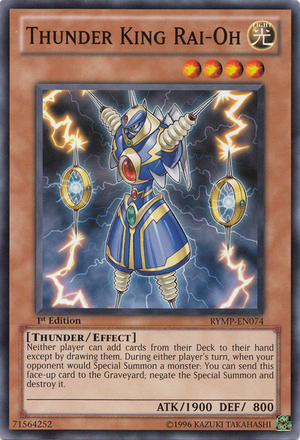
Thunder King Rai-Oh, second effect is pretty much unuseful here, but can still be used, however it is the first one that we need. Lock SS with Aurora, stop NS effects with Aurora, stop searching with this, opponent will just go crazy.

Tour Guide from the Underworld+Sangan, Sangan's a searcher, and even if I hate to admit this (again, I said the same thing in the Iron Chain post), Tour Guide is needed. Provides a beatstick (Leviathan or Acid Golem) and a "survivor" monster that destroys nasty things (Zenmaines), other than searching sangan, in some builds. In chaos builds it provides other than the thing said up here, even dark monsters and a retriever from the Banished Zone (Leviair).

Black Luster Soldier - Envoy of the Beginning+Chaos Sorcerer, yeah, chaos monsters, they're broken, if you can play them why not? The concept is, 'till you have Aurora it is ok, if you haven't, you can use those to win.

Safe Zone, protects your Aurora, and you can use it on your opponent's monster when he blind-MST  you or uses Heavy Storm. Good Card is Good.
-Imperial Custom, protects your Order, but even Safe Zone. If you reach a field like Aurora, Safe Zone on Aurora, Order and Imperial Custom, you should win.
--Fiendish Chain, this card is like a veiler that stops attacks too. If you're playing Imperial Custom, this card could be more good than it is now.
---Magic Planter, if you're playing that lot of continuous trap, Magic Planter could be good, not too much for the draw power (really good draw, though), but to get rid of some cards that are there for no reason, like fiendish that belonged to a monster used to XYZ.

Shining Angel, this card was good back in times, but right now Battle Summoners (or Recruiter, it's up to you how you want to call them, I prefer the second one) are slow and weak.

Gorz the Emissary of Darkness, this card is really good, stops a lot of decks, random OTKs, but if you can throw that against Six Samurais or Rabbit, opponent won't be able to recover fastly from this. You could think that with this lot of cards that tries to stay on the field, this card is bad, right? Well, that could be possible, but think of this: cards that will likely stay on the field are fiendish chain, either face-up or face-down, that means you have or that you can stop an opponent's OTK by stopping the main card's effect, Order, means you can stop a lot of opponent's card that could lead to an OTK, Aurora, means that you can stop opponent's summon since he does normal summon a monster to destroy your aurora, means you will remain with no cards on field and be able to Summon gorz. So if your opponent  stops your cards that will stop him, you'll be able to summon Gorz and stop him however.


This deck could be difficult to play sometime, expecially when you have multiple cards that activates when a monster is normal summoned. Here is how to play with them:
Order must be chained directly to the monster's effect, means that the effect must be last chain link. If you have Wanghu and Aurora and Order, and your opponent summons damsel, what will happen? SEGOC applies here. You'll of course want to destroy damsel and draw a card while keeping Aurora, so you'll need to make Wanghu Chain Link 1 and Aurora Chain Link 2, so that you will be able to (in order) draw a card, keep Aurora and destroy damsel.
You need to be careful while playing this, and be aware of the fact that if you have Order and Aurora on the field at the same time, you won't be able to stop opponent's effect with Order.

The Various Variants are:

Classic one, throw in the engine and some cards that doesn't interfere with that, some antimeta cards and that's all.
It is good, plays to stop every opponent's move, but could be somehow slow and if your opponent can summon a big monster some way, you won't probably be able to take him down.

Chaos Build, throw in the engine, some Doomcalibers, tour guides, TK, spirit reaper (for some match ups, and is dark and has a good effect).
Another good build, plays to stun your opponent mainly, without letting him combo. Deals best with big monsters, can take down by attacking everything that has 2999 or less ATK, and every monster with the banishing effect of BLS and Sorcerer.

Continuous Trap Build, plays to stun your opponent, has good draw power, and good beatstick. It could be the best one if it wasn't for the fact that it does clog easily you s/t zone, meaning you'll need both Skill and Luck to play this deck.

Counter Fairies Build, this is the one the fruit that falls farest from the tree (it is used in italy, don't know if it is used even in other countries, means that is is totally different from the one where you started from, like taking a different way from the original one). Throw the engine in a counter fairy deck, adjust something to take out cards that could interfere with the lock.
Haven't tried this, is an Idea I've got while writing the post, but theorically this should work good. Could take off monsters of good size, stuns a lot, has a lot of destruction and draw power. Yeah, really, should work.

Overall: deck has potential, it had more in the past but still now it is possible to be played and can be used without any problems in this meta while stopping a lot of decks. It is hard to play, so if you're looking for an auto-pilot deck, this isn't for you, really. Be sure to know perfectly the arguments in this post, expecially the SEGOC one.

08/06/2012

Useful Rulings and Game Mechanics #3: Spell Speed and Various Types of Effects

Here we are, this is the third post for Useful Rulings and Game Mechanics, here I'll post some rulings and game mechanics regarding Effects, Let's Start:

Spell Speed, What's that? What does it helps in?
Spell Speed is a way to classify the speed of an effect, and 3 types of it exist, Spell Speed 1, Spell Speed 2 and Spell Speed 3. You can chain to an effect only effects that has a Spell Speed greater of equal, except for Spell Speed 1, if an effect doesn't specify that. However, only effects have Spell Speed, attacks and summon doesn't, so if you summon a monster, you won't be able to activate bottomless trap hole, following this reasoning. For this, exist the possibility to use a card to "Respond" to an action. This means that you can activate a card when something happens to respond at that, nothing else. Spell Speed 1 are some Spells and all of the monster except for Quick Effect, Spell Speed 2 are Quick Effects, some spells and some traps, while Spell Speed 3 is made only of Counter Traps, nothing else.


Types of Effects, What are the various kind of them? What are the differences between them?
There are a lot of effects, but there are 2 types of effect and under them you can place all of the other: Optional and Compulsory, I talked a bit about them on the first post of Rulings and Game Mechanics explaining SEGOC and chains, be sure to have read that before continue reading this.
Under those two categories we have a lot of other kind of effects, I'll list and explain them here:

Trigger Effect, they are called like that cause they are activated when something happens, all of the Monarch are under this category, because they activate when they are tribute summoned, but even cards that activate when other cards do something, just think of Aurora Paragon, he destroys himself when some monster is normal summoned. However those effects aren't only activated when a monster is summoned, but even when a card is activated, a card is sent to the graveyard and so on. Another category of Trigger Effect exist, it is called Pseudo-Flip Effect, but I'll talk about that later.

Ignition Effect, those are effect that are activated "manually" by the player that control that card. Those effects are usually activated in main phase 1 or 2, except rare cards like Red-Eyes Wyvern. An example could be Rescue Rabbit. If you were playing yugioh before April 25th (for TCG players) or before March 19th (for OCG players) you should know that there were a thing called Priority. I wrote about its disappearance in this post. So if weren't playing before those dates, don't continue reading this paragraph, that could confuse you.
Basically when priority existed, you could have activated Ignition Effect of monsters at the same time of when they were summoned. With Effect Veiler that wasn't a problem, if you activated gale's effect at the same time it was summoned using priority, you could have negated that with Veiler and nothing happened, but the problem is with card that tributes, bounces back, remove themself for COST. As you should know costs are payedat the card's activation, so whatever was going to happens, you paid already the cost, it's like going to an Ice-Cream Shop and paying before you can get your Ice-Cream (here in Italy it is used, I don't knwo the situtation in other countries). Coming back to our topic, if you used Rescue Rabbit's effect with priority, he would remove himself and be immune to Effect Veiler, since he was no more on the field after your opponent has paid the cost and you were stuck with an Effect Veiler in hand with nothing to negate, cause there was no poin in negating laggia if you weren't going to activate a trap after that.
However without priority, this is no more possible and you need to wait till there is no more resolving, so you can avoid those kind of things with a destruction card before they can activate their effect, like Raigeki Break or Effect Veiler before your opponent could activate their monster's effect (because all of the monster's effect are Spell Speed 1, except for Quick Effect (known before as Multi-Trigger Effect, but I'll talk about them later).

Continuous Effect, are effect that don't activate, so that they don't start a chain. An example could be Aurora Paragon, again, since his first effect is continuous, not that when a player attempts to Special Summon a monster, this card suddenly activates and stops the opponent from doing so, he just totally stops Special Summons. Because of that, those monsters' effects can't be negated with Divine Wrath, because with that you can negate an effect that "activates" in that moment, but they can be negated by cards that totally nullify card's effects, like Skill Drain. However, sometimes, there are effects that can confuse you, like Bontiful Artemis. Even if this card's effect is triggered when a counter trap activates, it still is a continuous effect. You can guess that by the fact that you draw DURING the chain, and you know that it is impossible for a card to activate during a chain, meaning that you will be able to draw when the counter trap resolves because it is a Continuous Effect.

(Pseudo-)Flip Effect, they are effect that have "FLIP:" at the start of the effect, meaning that its effect works when it is flip summoned or turned from face-down position to face-up (no matter if ATK or DEF position). Ryko, Lightsworn Hunter is the best example for this. However there are cards that flip some monsters face-up, but clearly state that Flip Effect aren't activated at that time, reason why Pseudo-Flip Effects exist. Basically those cards don't have a flip effect, but they have a trigger effect that activate when they are flipped face-up from face-down. Most known card with this effect is Fossil Dyna Pachycephalo. However, don't confuse them with Flip Effect, they are simple Trigger Effect as they activate when a thing happens (being flipped face-up in this case).

Quick Effect, they are the only Spell Speed 2 monster's effects. They usually have the string of text "You can activate this effect during either player's turn". You should notice however that some Quick Effect can't activate twice or more during the same chain. The most known card with this effect is Light and Darkness Dragon.

Lingering Effect, I believe this one is the less-known kind of effect ever. Bascally this kind of effect activates after the card that generates that effect has resolved, like Final Countdown. This kind of effect can't be negated, except by negating directly the source of the effect at the activation, like Judgment on Final Countdown at its activation.


Hope this helped and, sorry, no images, but today my pc is somehow slow and images weren't totally needed here, am I wrong?
See Ya.

05/06/2012

Useful Rulings and Game Mechanics #2: Kind of Summons, Inherent Summon and External Effects that Cause Summons and How to Negate them

Wasn't sure under what label post this, if in tips for pro playing or rulings, but since this one is going to be a giant post, that would be a giant rule.
Make sure to have read this or know the argument "Chains" good before reading this.

Basically, what are the two kinds of Summons? Normal Summons and Special Summons, I think everyone knows 'till here.
Normal Summons are limited to once per turn, this is a game mechanic (or rule, call it as you want, I'll call them Game Mechanic, but think at them as you want), but there are cards that can freely break this one, like Double Summon or Ultimate Offering, making possible summoning more than a time per turn. The latter breaks another Game Mechanic, the one that says that you can Normal Summon only during your turn, making possible to summon during opponent's battle phase. However breaking Game Mechanics like this isn't a bad thing, because it is expressed by the card itself, so it isn't like "breaking" them, but more likely "ignoring" them giving an higher priority to the cards' effect. In this kind of summons are included gemini summons, normal summoning a gemini monster while he's on the field.

Then there is another kind of Summons, Special Summons. In this kind of summons are included ritual summons, performed via a ritual spell card, fusion summons, performed via polymerization or cards like that, contact fusion summons, performed with two monsters on the field that fuse without using any other card, Synchro Summons, performed via 2 or more materials, and one needs to be a tuner monster (it is specified what kind of monster you need to synchro, but usually they are a tuner and 1 or more non tuner monster), which the sum of their level is equal to the monster you need to summon, XYZ summons, performed via overlaying 2 or more monster with the same level to summon a monster that has a rank (not a level) equal to the level of those monsters, and Chaos XYZ Change Summons, by overlaying a given XYZ monster to summon another one, it is specified on the card what kind of monster you need in order to summon him, Inherent Special Summons, Special Summons caused by the card that's going to be summoned itself or by game mechanics (all of the kind of special summons listed before are inherent special summons because they were caused by game mechaincs), and lastly Special Summons caused by other cards' effect, cards like monster reborn.

That was a long introduction, wasn't it? Well, now let's arrive to the point of the post. A lot of people don't see the difference between inherent summons and other kind, so let's explain them.

Let's see a card:
Neither player can add cards from their Deck to their hand except by drawing them. During either player's turn, when your opponent would Special Summon a monster: You can send this face-up card to the Graveyard; negate the Special Summon and destroy it.
This is the main card that causes problems with other player, someones say that you can negate the summon of a monster summoned via monster reborn with this, but they are wrong.
Let's think about it and examine his effect:

During either player's turn, when your opponent would Special Summon a monster: You can send this face-up card to the Graveyard; negate the Special Summon and destroy it.

So, basically, what does it says? It says that by tributing himself you can NEGATE the summon of a monster. Does this remember you something? Yeah, it does, read the other "Useful Rulings and Game Mechanics post" (I linked it at the start of the post). It is like Solemn Warning. 
We said in the other post that Solemn Warning needs to be chained directly to the effect you need to negate because it NEGATES a card's summon/effect. This one is the same, but why this can't negate Reborn while solemn can? Because Solemn says:

When a monster would be Summoned, OR when a Spell Card, Trap Card or Effect Monster's effect is activated that includes an effect that Special Summons a monster(s): Pay 2000 Life Points; negate the Summon OR activation, and destroy that card.

The bolded part is the one we need, it can negate the activation of a card that Summons. But why Rai-Oh can't?
Well, we'll need chains here.
As you know you can't use an effect while a chain is resolving, so let's think of a chain with only a chain link.
Player B uses Monster Reborn targetting Hyperion in the Grave while Player A has Rai-Oh on the field, a chain is formed. No one chains nothing else, because Rai-Oh can't be chained to a card that SS another card. Resolving the chain we'll SS Hyperion from the grave, and since we are resolving a chain, player A can't negate hyperion summons, because, you know, you need to chain a card that negates directly to the card you need to negate. Hyperion will safely be summoned and he will (probably) kill Rai-Oh attacking him totaly fucking-up player A.

By reading the other post you'll know why Bottomless can destroy and remove Hyperion at that point.
So, Rai-Oh can negate only Inherent Special Summons. So you can negate a fusion summon, a synchro summon, an XYZ summon, the summon of (for example) Cyber Dragon, but not the SS of (for example) Sangan summoned via tour.
To recognize easily non-inheren special summons you can check the card text that has the problem solving card text in it. If it has a colon ":", it isn't an inherent special summon. For example: (Gorz the Emissary of Darkness)

When you take damage from a card your opponent control: You can Special Summon this card from your hand. You must control no cards to activate and resolve this effect. When Special Summoned this way, activate the appropriate effect, based on the type of damage.
● Battle Damage: Special Summon 1 "Emissary of Darkness Token" (Fairy-Type/LIGHT/Level 7/ATK ?/DEF ?). Its ATK and DEF are each equal to the amount of Battle Damage you took.
● Effect Damage: Inflict damage to your opponent equal to the amount of damage you took.

The effect that summons himself isn't inherent because of the colon, the effect from battle damage isn't inherent because it does summon another card and the third doesn't summon anything at all.

There's still a little more tricky card we need to see:

While this card is on the field: Either player can Fusion Summon a Fusion Monster without using "Polymerization", but the Fusion Material Monsters are banished instead of being sent to the Graveyard.
How does Fusion gate works? Let's see it.

While this card is on the field: Either player can Fusion Summon a Fusion Monster without using "Polymerization", but the Fusion Material Monsters are banished instead of being sent to the Graveyard.

There are colons at the start, so even if it is a Fusion Summon, it is a non-inherent summon.
This card is one of the trickiest card ever. We know that TK can't negate non-inherent summon, so he is out of our game. After have read this pretty much everyone that doesn't know this card well would say "Solemn Warning FTW!!!". But he/she would be wrong. What does Solemn Warning exactly do? Solemn can only negate inherent summons and cards that generate summons, BUT, reading it closely you'll see that it says "when...is activated", so it can stop it only when you activate that card, even if you aren't going to summon anything, just like how you can negate Starlight Road or Macro Cosmos with Solemn Warning. So either you stop this card on the activation, or you bottomless the monster summoned or you MST Gate after they removed the materials (being a field spell, it needs to be on the field to apply its effect, so you'll make your opponent remove fusion materials and nothing will be summoned.

If you've learned everything that is written here, you need to learn when and how to apply it.
I'd recommend to study this for random cards like call of the haunted, monster reborn, tour guide from the underworld, but even for Gladiator Beasts, HEROes and things like that. Well, was a long post, but I think it was pretty easy to read because of images and random text. Well, That's All Folks.

01/06/2012

Useful Rulings and Game Mechanics #1: Effects Vs. Costs, Chains and SEGOC

I said in the other post, rule n.7 to be precise, the importance of rulings. Well, I'm now going to explain some useful rulings, I applied them in a lot of duels. Let's start.

Effects Vs. Costs, How are they different one from the other?
Basically effects are applied during the resolution of a card, while costs are paid at the activation of the card, reason why a negated Solemn Judgment will make you pay half of your life points no matter.
I said this first because this will be helpful in pretty much every ruling or to understand some game mechanics, like the one that will follow.

Chains, What are they? How do they work?
A chain is formed when 2 or more effects are chained one at the other, so when one is activated following another one. When a card is activated in a chain, it is considered a Chain Link, they are numbered and they resolve backward. Some things happens while resolving a card effect, so while resolving the chain, others happens while paying the cost, so while activating the card.
Example: I activate Enemy Controller, for his cost I tribute my Treeborn Frog and select my opponent's Inzektor Centipede, then my opponent activates Call of the Haunted. Now Chain Link 1 is Enemy Controller, Chain Link 2 is Call of the Haunted. Resolving backwards your will first SS his selected monster and then your E-Con will take control of your opponent's centipede.
You can't absolutely take control of the monster reborned with Cal of the Haunted because you selected the monster you wanted to take during the activation of your card.
In the meta before this there was a combo used by pretty much everyone, Trap Dustshoot+Mind Crush, it basically let you watch your opponent's hand, send back a card and then discard one or more of them (if they had multiple copies of a card in their hand. There was a question that a lot of newbies asked, "Is it possible to chain one to the other to let the combo work?". The answer obviously is no. Why? Mind Crush asks you what card you want to check during the activation of the card, while Trap Dustshoot's show effect works during resolution, not lettin' you never watching opponent's hand before saying what card to discard.

SEGOC, What does it stands for? What is it?
SEGOC, Simultaneous Effects Go On Chain. You could have guessed by the name what it is, basically, if 2 or more effects activates at the same time they form a chain and no one lose timing, they go on chain following some rules and the others are choosed in which order they should activate.
The rule that rules the order is: (taken from Yugioh Wikia)

  1. Turn Player's Mandatory Effects
  2. Non-Turn Player's Mandatory Effects
  3. Turn Player's Optional Effects
  4. Non-Turn Player's Optional Effects

What happens if a player has 2 or more effects of the same type? Simple, that player choose the order they activate. You're thinking (if you're new to this rule) "how could this help me? It won't help me, of course". Well, you're wrong. Let's examine 2 cards and an Archetype:

Activate only when your opponent Summons a monster(s) with 1500 or more ATK. Destroy and remove from play the monster(s).

When a monster would be Summoned, OR when a Spell Card, Trap Card or Effect Monster's effect is activated that includes an effect that Special Summons a monster(s): Pay 2000 Life Points; negate the Summon OR activation, and destroy that card.

What does these 2 cards have to do with us right now? Well, let's examine some rulings that we are interested in, first.

BTH's effect says clearly that you can activate that card when a monster is succesfully summoned, this means that you need to activate this card right after the chain ends, and only if the monster you want to remove was Chain Link 1.

Being Solemn Warning a counter trap, it needs to be activated directly after the card you want to stop, meaning that if the card you want to stop is chain link 2, this card must be chain link 3, no more, no less.

Well, the archetype that helps explaining this the best is Dark World. They have Optional effect but no one of them can lose the timing because of che "If...You can" part. Let's take in consideration a lucky hand:
Card Destruction, Sillva, Goldd, Grapha, Broww and Snow. Opponent's has 2 face down cards, let's assume they are a Solemn Warning and a Bottomless Trap Hole, and we know that for some reason. What would you do now? We'll activate Card Destruction and blow-up our own ad our opponent's hand to draw. Then all of your monster's effect activate, and, following SEGOC, you can choose in which order they can activate. Possibilities are 24 (if I'm not wrong), and they may seem all the same at your eyes, but that isn't true. Let's take in consideration 2 facts:
-We need to search with snow first and then to draw with broww, no matter when they activate, important thing is that they do that in this order;
-We need to avoid those two set cards.

Let's think. First point isn't hard to achieve, we just need to put Snow in an higher Chain Link than Broww, so that reslving backward we'll first search and then draw, but for the second one? Simple, we just need not to put any of the monster that summon themself in chain link 1 or 5 and we are done.
Possibilities are lower right now, they are 6 and no one of them will affect your game at all.
I would apply this: 
CL1 Broww
CL2 Grapha
CL3 Goldd
CL4 Sillva
CL5 Snow

Well, this was a wall of text, hope I lightened it with these 2 images. I liked this post, it helps me remember some rules that I usually forget but that could have helped me a lot sometimes, so I think I'll continue doing things like this.

26/04/2012

Comparing Cards: Solemn Warning Vs. Bottomless Trap Hole

Yeah, another comparing cards post, I like it, it isn't difficult to write, it really helps a lot players deciding what to play, it makes up my mind, sometimes I have confused ideas about some cards, like the 2 of today, and writing this helps me too.

I said the other post will be regarding no-priority rule in TCG, Bottomless against Solemn Warning, I think it does make sense, right?
When Solemn Warning got printed, it was treated like a god card because it may help stopping ignition effects used with priority and trigger effects (if you don't know what this does mean, read the previous post). Before this, Bottomless Trap Hole was the main resource against summons, but it didn't work with monster under 1500 ATK and doesn't stopped Ignition and Trigger effect.
So why am I even comparing them? Warning only adds the cost of 2000 LP, it is alot better compared with bottomless, it even negates igntion effect with prior- RIGHT, no more prio, this makes this card alot more playable.
As always, let's start with PROs and CONs:

Warning need 2000 LP to work, Bottomless does not.
Because of the previous, Warning may be a dead card.
Warning only destroy, Bottomless banishes too (but this may be a con for bottomless, if you want to know the reason, read the other comparing cards post).

Bottomless doesn't work against monster with less than 1500 ATK, Warning does (big con for bottomless, no rabbit and alot-of-others-monsters-very-important-in-this-meta hate).
Bottomless doesn't stop trigger effect, Warning does.
Bottomless is only SS2, Warning is SS3.

Yeah, there wasn't too much to say, so let's go directly to the overall impressions:
Warning is way more better, but it depends on player's play style and deck, if it is a deck that risks alot of damage, warning may easily become a dead draw, if you are going into a macro deck however, banishing effect of bottomless is totally unuseful, so warning is better. As said, it depends on player and deck.

This was all for today, I think.

See ya.

Priority Gone, no more rabbit abuse hopefully

Hurray!!! I hate peoples on Dueling Network that saying "I'm playing OCG", "I'm playing TCG" say "there isn't priority" or "there's still priority", then we start discussing and I lose interest in playing because I'll probably be in a bad mood.

For persons who doesn't knor what priority is I'll explain better: priority means the capability of the turn player to activate an Ignition effect of a monster yet summoned, and bypass Bottomless/veiler letting you use that monster's effect. Remember the difference from Ignition and Trigger effect. A trigger effect is an effect called like that because it is triggered from some situations, like the monster's own summon, an example may be Monarch. An ignition effect is an effect, usually once per turn, but not always, activated by the player who controls that monster during main phase 1 or 2, an example may be Rescue Rabbit, reason why a lot of players are happy of this changement.

Basically before this changement, one could summon rabbit in turn 1, use effect with priority and avoid veiler, summon laggia/dollka and fuck the opponent. Now one could summon rabbit in turn 1 and just hope opponent doesn't have veiler, if he does have him, well, you've lost a rabbit without reason, because opponent will summon a monster and attack your rabbit. SO, with this change 3 veilers are really recommended in every deck.

I'll write something else about this changement, I think i'll write it today.

That's all folks.

P.s. I was planning on writing this yesterday, but sadly connection disappeared (that's the right word, suddenly on the list of wireless connection, my list disappeared, not even a loss of signal first, it disappeared and stop, nothing else)